
State Literacy for Social Work
Two Body Learners. One Encounter. A Relationship That Continues.
A 3½-hour experiential professional learning institute for social workers, caseworkers, and human services teams.
What if understanding your own physiological responses could change the way you experience—and respond to—the people you serve?
Every social work encounter involves more than the behavior we can observe.
Two human beings enter with histories, expectations, professional responsibilities, and physiological processes already underway. Each is continuously taking in information, anticipating what may happen next, and responding.
And sometimes, all of that begins before a single word is spoken.
State Literacy makes this invisible dimension of human interaction easier to recognize.
What Is State Literacy?
State Literacy is a framework for understanding the physiological processes occurring beneath observable behavior—in ourselves and others—and how those processes may influence our access to our capabilities.
The framework introduces:
Two Learners: The Body Learner and the Cognitive Learner
Three Questions: Am I safe? Do I belong? What happens next?
Four States: Settled, Activated, Overwhelmed, and Survival
The goal is not to diagnose another person's internal experience or eliminate professional accountability.
It is to become more skillful at recognizing the processes that may be influencing an encounter, including our own participation in it.
Access changes before behavior changes.
A Different Kind of Professional Learning
This is not a lecture about managing difficult clients.
It is an interactive learning experience in which participants follow a social worker and a parent through a continuing relationship.
They experience how expectations develop, how physiological states may shift repeatedly within a brief conversation, and how professional responses contribute information that both people may carry into future encounters.
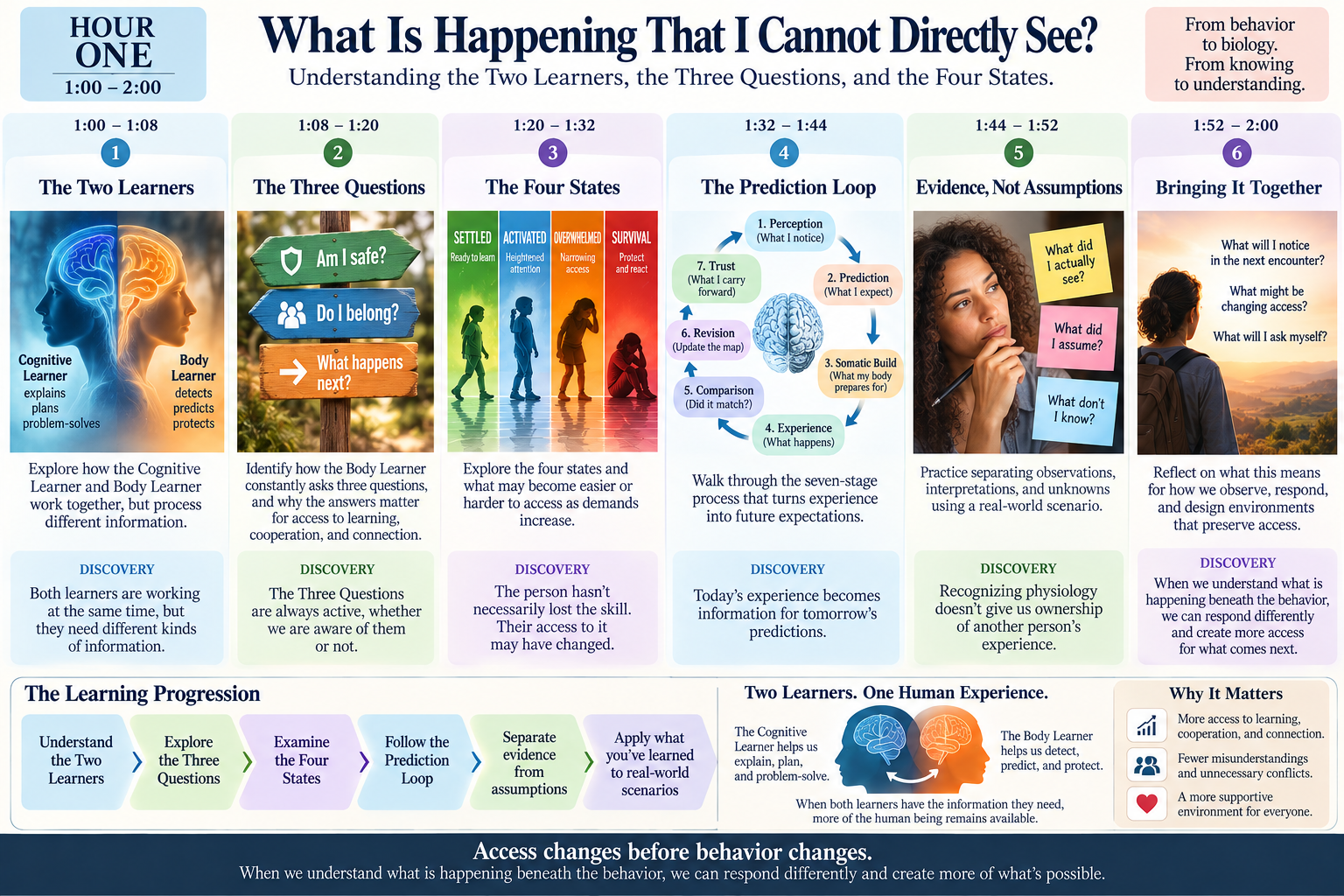
Hour One: The Human Before the Case
Recognizing what we cannot directly see.
Participants explore how the same encounter may be experienced differently by two people.
Through perspective-taking, dialogue, observation, and rehearsal, they begin separating what they know from what they assume.
Key discovery: Understanding behavior begins with recognizing that physiological processes are always occurring beneath it.
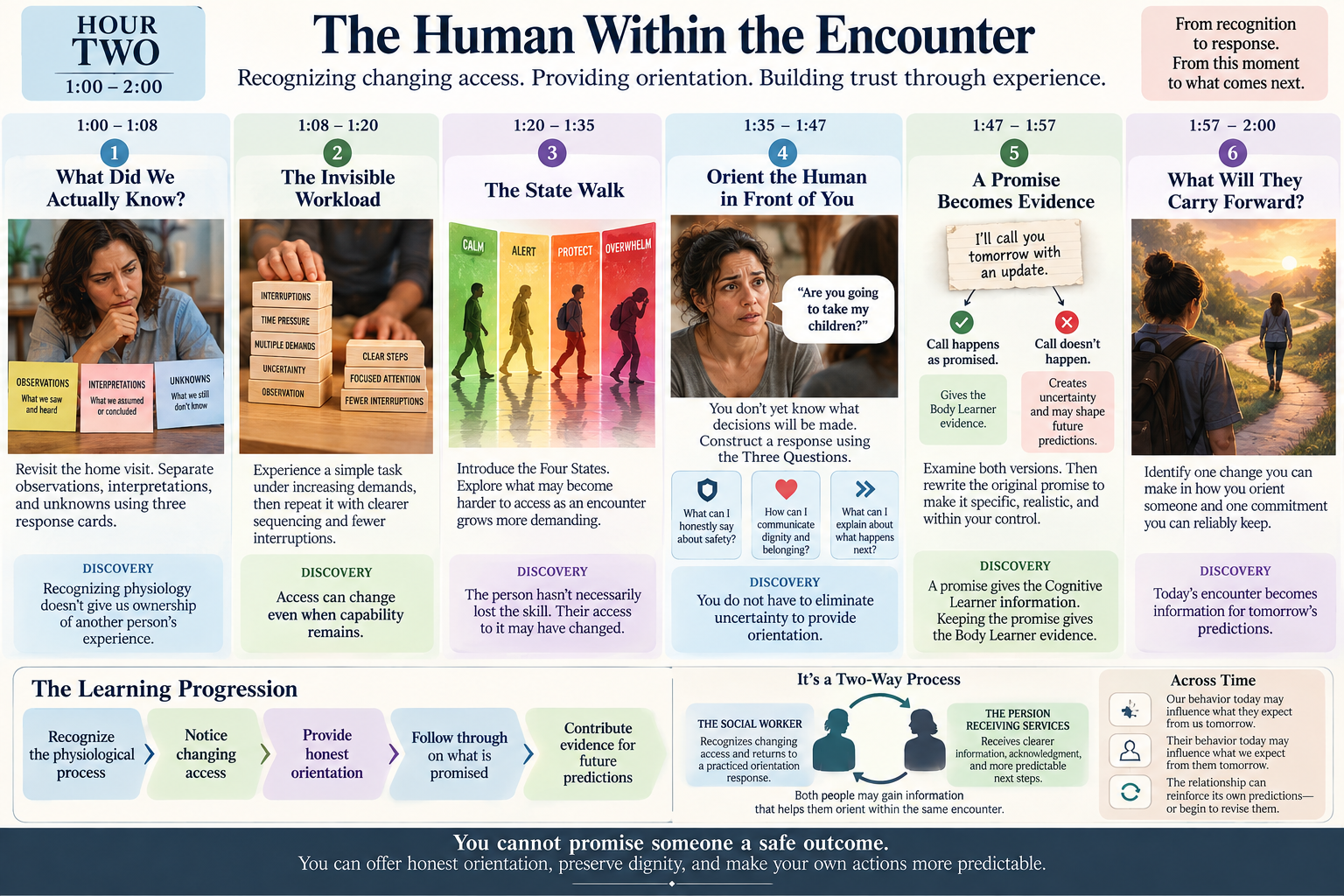
Hour Two: The Human Within the Encounter
Recognizing ourselves as participants in the interaction.
Participants explore how their own need for orientation may influence their interpretations, decisions, and responses.
They practice providing honest orientation, recognizing changing access, and making commitments they can realistically fulfill.
Key discovery: We can find our own orientation without taking ownership of another person's experience.
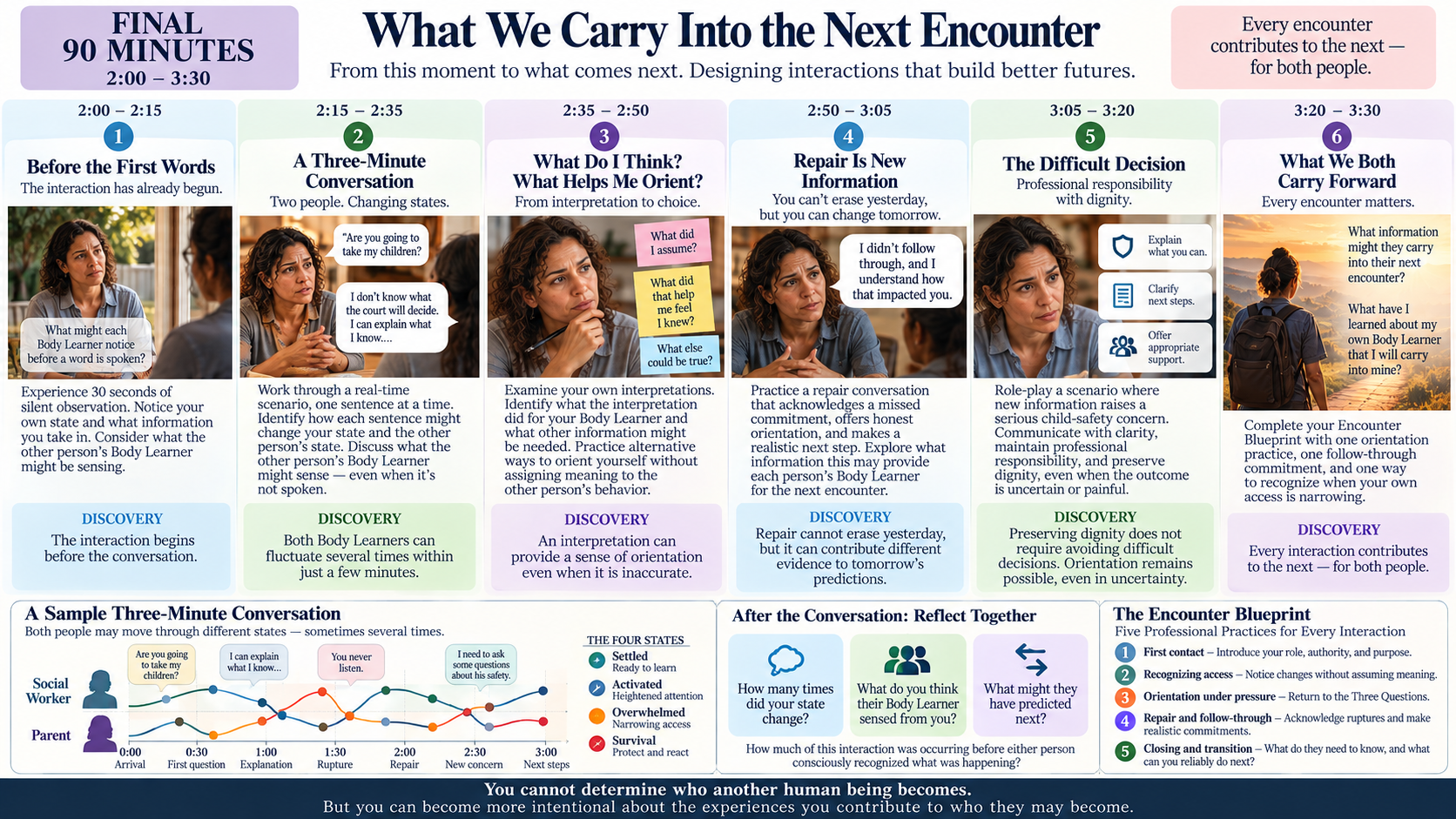
Final 90 Minutes: What We Carry Into the Next Encounter
Understanding how experiences become information for the future.
Participants follow an evolving conversation, sentence by sentence, and consider how their own states might change within just three minutes.
They explore what another person's Body Learner might sense, how predictions influence responses, and how repair and reliable follow-through can contribute new information.
They finish by designing practical approaches to first contact, orientation, professional responsibility, repair, and transition.
Key discovery: Every interaction contributes to what comes next—for both people.
The Three-Minute Conversation
Imagine a social worker hearing:
“Are you going to take my children?”
What happens within the social worker?
What might be happening within the parent?
What changes when the social worker responds?
What might each person's Body Learner sense before either consciously recognizes the exchange?
During this exercise, participants explore how their physiological states and access to capabilities might fluctuate several times within one conversation.
Your Body Learner may be communicating information that another person's Body Learner is already using—even before either of you consciously recognizes the exchange, or before a word has been spoken.
What Participants Take Away
Participants leave with a practical State Literacy Encounter Blueprint and opportunities to practice:
Recognizing their own changing state and access
Separating observation from interpretation
Offering honest orientation without false reassurance
Maintaining professional responsibility and appropriate boundaries
Repairing ruptures and following through on realistic commitments
Considering how today's interactions may influence tomorrow's expectations
State Literacy complements—not replaces—professional ethics, safeguarding procedures, supervision, and established social work practices.
Bring State Literacy to Your Team
Professional learning that begins with understanding the human being—including the professional.
Designed for social work teams, human services organizations, case management programs, and interdisciplinary professionals.
Explore bringing the 3½-hour State Literacy Social Work Institute to your organization.
Contact Katherine Wiseman
Founder, Bodies Make Sense
Professional Learning • Consultation • Speaking