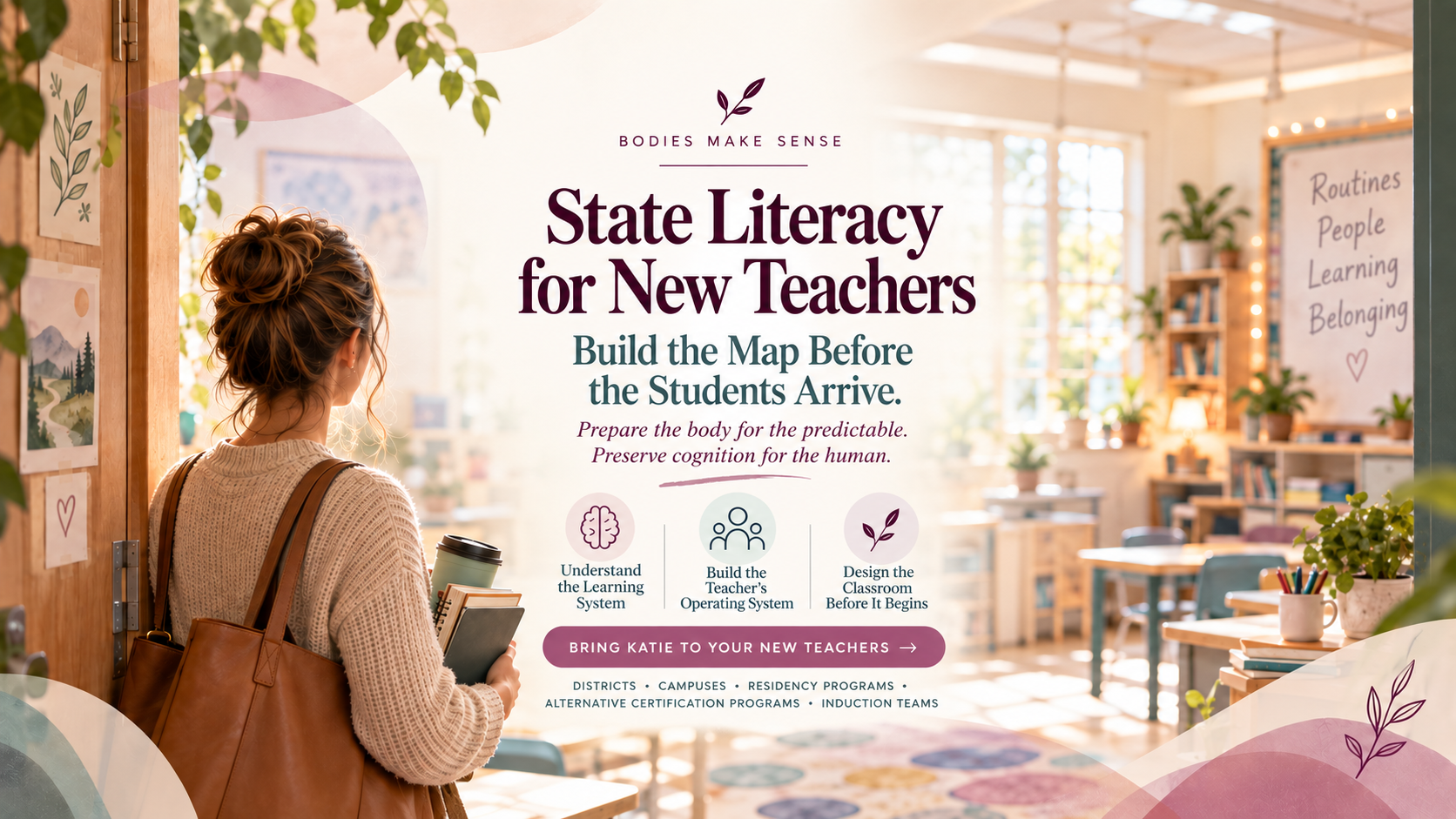
A half-day institute for new teachers and the people who support them.
New teachers are asked to manage an enormous number of unfamiliar demands at once. This institute helps make the predictable parts of teaching more familiar before pressure rises—so attention remains available for students, judgment, relationships, flexibility, and learning.
The first weeks of teaching are a shock to the system.
New teachers are not simply learning curriculum. They are learning an entire profession in real time.
Where do I stand?
What happens when technology fails?
Where do materials live?
What do I do when a student arrives late?
What happens when the room gets loud?
What do I do when three people need me at once?
Under pressure, even simple tasks can become harder to think through.
The goal is not to simplify teaching. The goal is to make the predictable parts more familiar before the stakes rise.
Prepare the body for the predictable. Preserve cognition for the human.
Three parts.
One operating system.
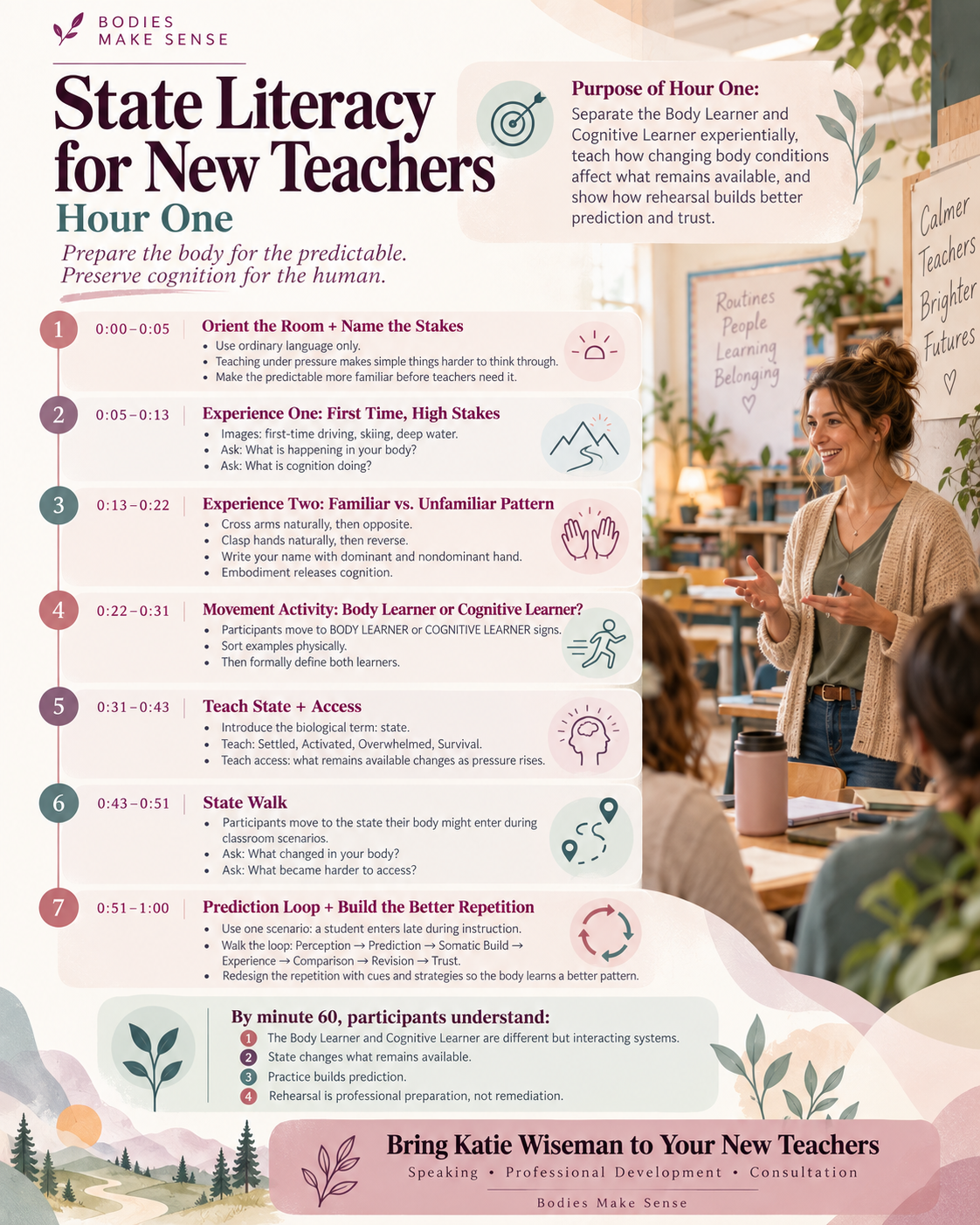
Hour One
Understand the Learning System
Participants experience the difference between the Body Learner and Cognitive Learner, learn how changing body conditions affect what remains available, and see how repetition builds prediction and trust.
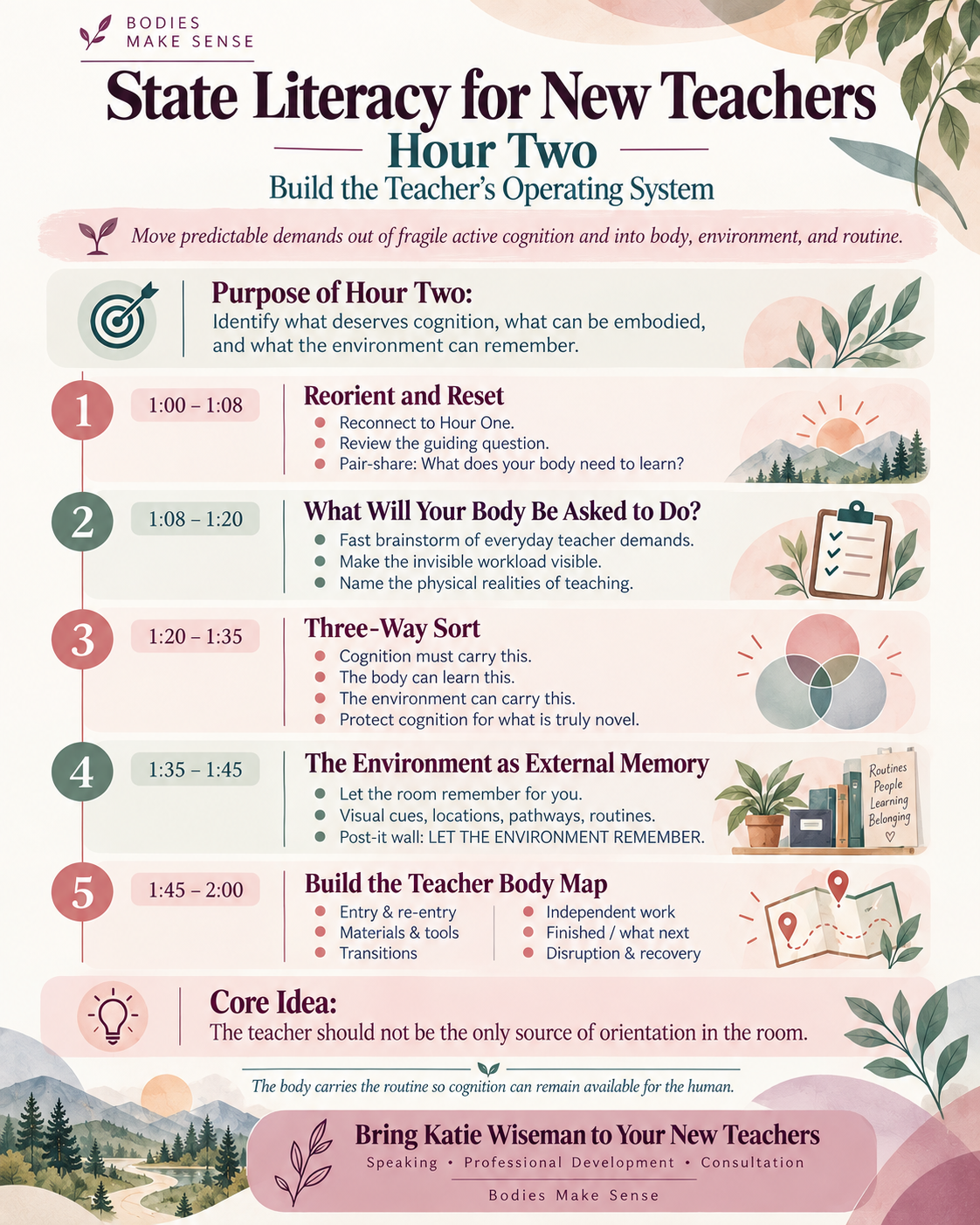
Hour Two
Build the Teacher’s Operating System
Participants identify what truly deserves cognition, what the body can learn through repetition, and what the environment can carry through cues, locations, routines, and design.
Final 90 Minutes
Build the Classroom Before the Classroom Begins
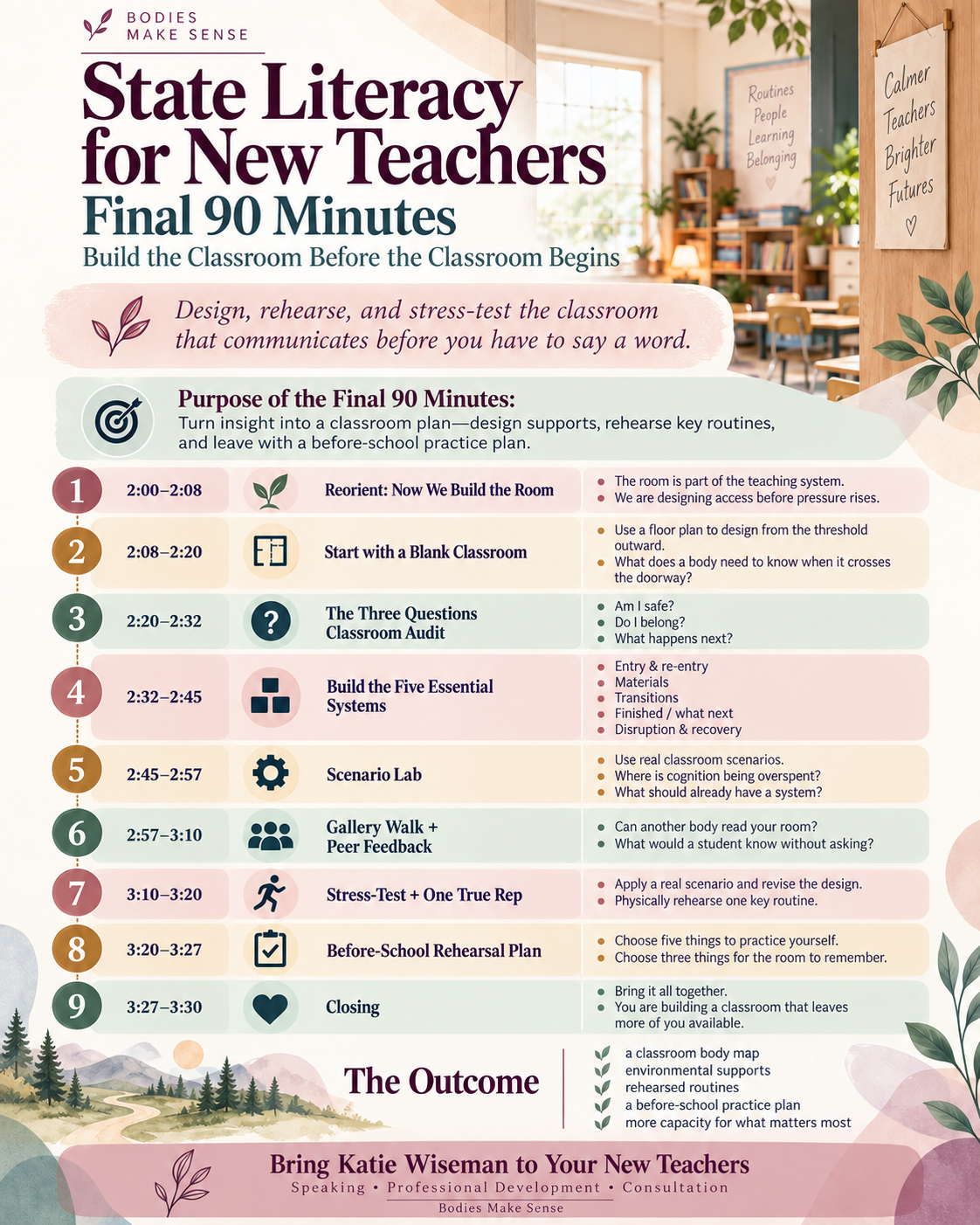
Participants design, stress-test, and rehearse their own classroom systems so they leave with more than ideas—they leave with a map.
This is not a sit-and-listen workshop.
Participants leave with:
a classroom body map
clear entry and re-entry systems
environmental cues that reduce cognitive load
routines for materials, transitions, finished work, and disruption
one or more physically rehearsed classroom routines
a before-school rehearsal plan
a clearer understanding of what they want their body to carry
a clearer understanding of what they want cognition available for
You are not building a classroom that runs without you.
You are building a classroom that leaves more of you available.
Designed for new-teacher development
District new-teacher institutes
Campus onboarding
Teacher residency programs
Alternative certification programs
Induction and mentoring teams
Special education new-teacher cohorts
The institute can be delivered as a stand-alone half-day experience or incorporated into a larger new-teacher learning sequence.
The training itself models the framework.
Participants do not simply hear about embodiment, prediction, state, and access.
They move.
They sort.
They notice their own bodies.
They rehearse.
They build.
They revise.
The institute uses the same principles it teaches: orientation, environmental support, repetition, movement, predictability, and reflection.
The method and the message match.
Bring Katie Wiseman to Your New Teachers
Give new teachers a chance to build the map before students arrive.
This half-day institute is designed to help teachers reduce avoidable cognitive overload, rehearse predictable classroom demands, and preserve more capacity for the human work of teaching.
Speaking • Professional Development • Consultation